
Granactive Retinoid vs. Retinol: Picking the Right One for Calmer, Happier Skin
If you’re weighing Granactive Retinoid against traditional retinol, unsure which is truly better for you, I get it. Let’s walk through this together, so you can choose with clarity, not confusion.
By the end of this guide, you will:
- Understand the science behind Granactive Retinoid’s gentler approach, so you know if it’s a fit for sensitive skin like my client Noah’s.
- Compare the real-world results and potential irritation of each formula, empowering you to match a product to your skin’s specific tolerance.
- Learn how to start using either one in your routine the right way, helping you avoid common pitfalls and see smoother, brighter skin.
Let’s find the option that makes your skin feel supported, not stressed.
The Retinoid Family Tree: A Simple Guide
Think of “retinoid” as the family name for all vitamin A derivatives used in skin care. They’re all related, but some are stronger and work faster than others.
I like to explain it with a car analogy. Prescription-strength retinoids like tretinoin are the high-performance sports cars. They’re powerful and get you visible results quickly, but they can be harsh and come with more potential for irritation. Over-the-counter traditional retinol is your reliable sedan. It’s effective for most people, widely available, and gets the job done with a bit more patience. Granactive Retinoid is like a smooth, modern hybrid. It’s designed to be gentler and more stable, offering a comfortable ride with less initial fuss.
Despite their differences, all retinoids share a common goal: they eventually convert in your skin into retinoic acid. This is the active molecule that tells your skin cells to renew themselves faster. This process helps clear clogged pores, smooth fine lines, and fade dark spots.
Meet the Contenders: Molecule Spec Sheets
Let’s look at the technical details side-by-side. This table breaks down how these two popular over-the-counter options differ at a molecular level.
| Feature | Traditional Retinol | Granactive Retinoid (Hydroxypinacolone Retinoate) |
| Common Names | Retinol, Vitamin A | Hydroxypinacolone Retinoate, HPR, Granactive Retinoid |
| How it Converts in Skin | Your skin must convert it in two steps: first to retinaldehyde, then to retinoic acid. | It’s a retinoid ester that can bind directly to skin receptors, acting more like retinoic acid without the multi-step conversion. |
| Typical Concentration Range | 0.1% to 1.0% in serums and creams. | Often used at 2% or 5% in formulations, but this represents the concentration of the complex, not the pure active. |
| Solubility (Oil/Water) | Oil-soluble. It’s often suspended in oils or anhydrous (water-free) formulas for stability. | Designed to be water-soluble. This allows it to be formulated into lighter, less greasy serums and gels. |
| Key Stability Notes | Famous for being unstable. It degrades quickly when exposed to light and air, losing potency. | Engineered to be more photostable and less prone to oxidation than pure retinol. |
A quick but important note: you’ll often see “encapsulated retinol” on labels. This isn’t a new molecule. It’s traditional retinol packaged in tiny protective shells (like microscopic bubbles) to shield it from degradation and sometimes to slow its release into the skin to reduce irritation. When comparing encapsulated retinol vs granactive retinoid, you’re comparing an advanced delivery system for an old ingredient to a newly engineered ingredient itself.
My client Noah, with his dry, reactive skin, often prefers starting with a granactive formula because the water-soluble texture feels lighter and it’s less likely to trigger immediate redness. Maya, who is acclimated to retinoids, sometimes chooses a well-encapsulated retinol for its proven track record and cost-effectiveness.
How They Feel: The Sensory and Side Effect Story
If you’ve searched “granactive retinoid vs retinol side effects,” you’re likely hoping to skip the worst part of retinoids: the initial irritation. Let’s talk about what that really feels like.
Starting a traditional retinol often begins with a phase called “retinization.” Your skin is learning to cope with the new active. This can look and feel like a sunburn for a few weeks. You might see redness, noticeable peeling around your mouth and nose, and feel a persistent tight, dry sensation. It’s your skin barrier getting a bit overwhelmed as the retinol converts to retinoic acid right there in your skin.
Granactive Retinoid is often associated with a smoother start. The reason is in its design. Think of the retinoic acid ester in Granactive as a pre-unlocked door. It’s already in the form your skin cells can use more directly, so it doesn’t have to do as much conversion work on site. This means less cellular commotion in your upper layers, which often translates to less visible redness and peeling.
My client Noah, who has dry, reactive skin, is a perfect example. A 0.3% retinol serum left his cheeks red and flaky for nearly a month. He switched to a 2% Granactive Retinoid emulsion. He reported a mild tingling for the first three nights and just a bit of tightness, but no dramatic peeling or redness. For skin types that are quick to protest, Granactive Retinoid can be a gentler way to begin the retinoid journey. That contrast also illustrates how retinol percentage and formulation jointly influence efficacy and tolerability. In practice, higher percentages can yield stronger results but may increase irritation, so personal skin response guides product choice.
Matching the Molecule to Your Skin Goal
Choosing between them isn’t about one being universally “better.” It’s about which tool is right for your specific job.
For Clearing Acne and Congestion
If your main goal is tackling acne, both can be effective. Traditional retinol is a proven warrior here. It speeds up cell turnover to prevent pores from clogging in the first place. For stubborn, deep cycstic acne like the kind Maya sometimes gets, the potency of a well-tolerated retinol can be very effective.
Granactive Retinoid also promotes turnover and has anti-inflammatory properties. If your acne is paired with sensitivity or redness (think papules and pustules rather than deep cysts), Granactive may clear breakouts without worsening the inflamed look and feel.
For Addressing Wrinkles and Texture
When we ask which works better on wrinkles, we’re asking about collagen. Both molecules ultimately signal your skin to make more collagen. The potential advantage of Granactive here is tolerability. If you can use a Granactive formula more consistently, without skipping nights due to irritation, you may see steadier, long-term results. Consistency is more powerful than occasional use of a stronger, harsher product.
For Oily vs. Sensitive Skin Types
Oily skin often tolerates traditional retinol quite well. My client Maya finds that a lightweight retinol serum helps regulate her oil production over time. For oily skin, the formulation (a light gel or fluid) matters as much as the active.
Sensitive skin, however, frequently leans toward Granactive. Lina, with her combination but reactive skin, uses a Granactive product only on her oilier T-zone and avoids her drier cheeks. It gives her the pore-refining benefit where she needs it without triggering flare-ups on her more delicate areas.
Understanding “Strength” Beyond the Percentage
Don’t get fooled by the numbers. A 2% Granactive Retinoid is not “stronger” than a 1% retinol. They are different compounds. The percentage tells you how much of that specific compound is in the bottle, not its final potency on your skin. Strength is a combination of the molecule’s design, its formulation, and how well your individual skin can process it. A lower-percentage retinol in a well-formulated base can be more effective than a high-percentage product that irritates you into quitting.
The Nuts and Bolts: How to Use Either One Safely
Whether you choose traditional retinol or a granactive retinoid formula, the application rules are nearly identical. Think of these steps as your universal guide to getting the benefits without the burnout.
Your Starter Retinoid Routine
- Start with a clean, dry face in the evening. Use a gentle, pH-balanced cleanser.
- Wait 15-20 minutes. This lets your skin’s pH normalize and ensures you’re applying your retinoid to completely dry skin, which minimizes potential irritation.
- Apply a pea-sized amount of your chosen retinoid product to your entire face, avoiding the immediate eye area and lips.
- Follow with your moisturizer. For most people, waiting a minute or two after the retinoid is enough before applying moisturizer to seal everything in.
- Begin by using it just one night a week. You can slowly increase frequency to every other night, and then nightly, as your skin tolerates it over several weeks.
Patience is not just a virtue with retinoids; it’s the key to letting your skin build tolerance and see long-term results. For men, a simple skincare routine with retinoids can fit naturally into nightly care. Stay consistent and you’ll notice smoother skin and lasting improvements.
The “Sandwich Method” for Sensitive Skin
If you have reactive skin like my client Noah, jumping straight to a bare-face application can be too much. The “sandwich method” is a gentler approach.
- Cleanse and dry your skin as usual.
- Apply a thin layer of a simple, soothing moisturizer first.
- Apply your pea-sized amount of retinoid.
- Finish with another layer of that same moisturizer.
This technique buffers the retinoid, slowing its delivery and reducing the chance of redness or peeling. It’s like putting on a soft base layer before a wool sweater. It also helps to repair your skin’s barrier for better results.
Why Vehicle Matters: Squalane and Barrier Support
Retinol and granactive retinoid are almost never used alone. They’re formulated into a “vehicle”-the cream, serum, or oil that carries them. This vehicle is crucial.
Many gentle formulas, like a granactive retinoid in squalane or a retinol in squalane, use this plant-derived oil as the base. Squalane is a component your skin’s own oil makes, so it’s deeply familiar and moisturizing. Choosing a retinoid in a barrier-supporting vehicle like squalane can help counteract dryness and keep your skin calm while the active ingredient works. It’s a smarter choice for anyone prone to dryness or sensitivity.
Contraindications & Safety Warnings: When to Press Pause
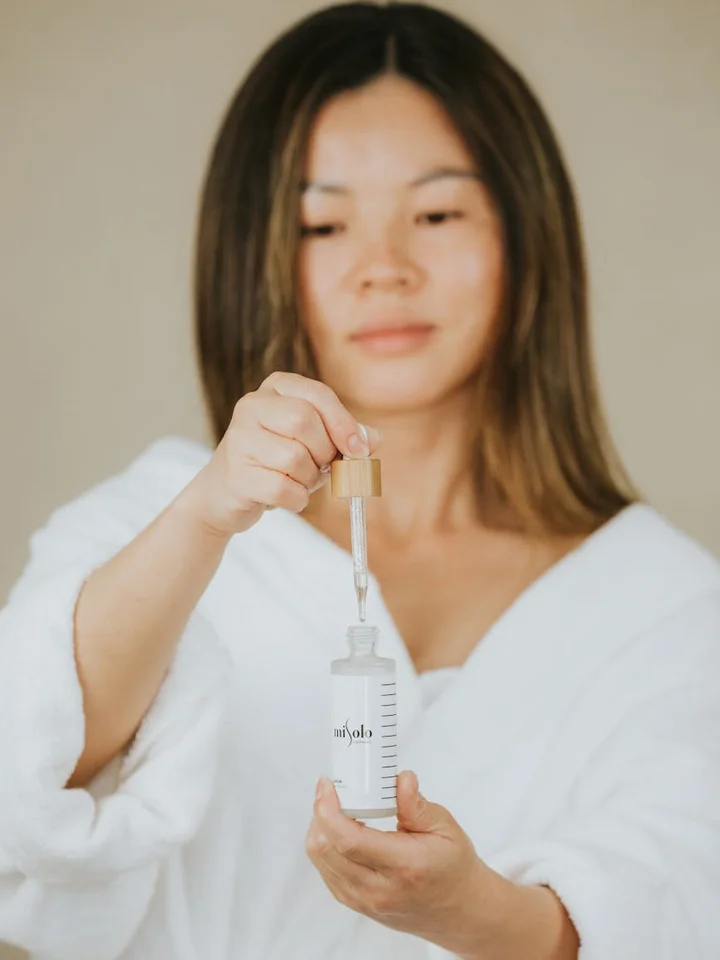
Retinoids are powerful, and that power means there are non-negotiable times to avoid them entirely. Your safety and skin health come first. If you’re considering retinol, knowing the appropriate starting age and safety precautions is essential. Details will be covered in the next steps.
Do not use any retinoid product-retinol, granactive retinoid, or prescription forms-if you are pregnant, breastfeeding, or trying to conceive. This is a firm rule from dermatologists. Consult your doctor for pregnancy-safe alternatives.
Other Times to Take a Break
Even if you’re a seasoned user, pause your retinoid if you encounter any of the following:
- A visibly compromised skin barrier: think widespread redness, stinging with any product, cracking, or extreme tightness.
- Immediately after any professional procedure: chemical peels, laser treatments, microdermabrasion, or dermabrasion. Wait until your clinician gives you the all-clear.
- During an active rash (like eczema or dermatitis), sunburn, or windburn. Your skin needs to heal, not be challenged.
- If you are using other potent exfoliants (like AHA/BHA acids) and experiencing irritation. Scale back and reintroduce one active at a time.
The Sunscreen Rule
Using a retinoid makes diligent sun protection mandatory, not optional. Retinoids increase your skin’s sun sensitivity and sun damage can reverse your progress and cause irritation. Apply a broad-spectrum SPF 30 or higher every single morning, without fail, even if you’re indoors. Regular sunscreen is a cornerstone of anti-aging protection against UV damage. It helps preserve skin tone and texture over time. This is the most important step in your routine to protect your investment and your skin’s health.
Making Your Choice: A Friendly Esthetician’s Checklist
Choosing between retinoids can feel like a chemistry test you didn’t study for. Let’s simplify it. Grab a cup of tea and ask yourself these two questions. We’ll skim the retinol vs retinal vs retinoic acid chemistry to see what matters.
What’s Your Primary Skin Goal?
Are you looking for a gentle introduction to retinoids? Is minimizing irritation your top priority? Granactive Retinoid is designed for this exact purpose. If your main concern is tackling established fine lines, pronounced texture, or stubborn acne with a time-tested ingredient, and you’re prepared for a potential adjustment period, traditional retinol is a powerful ally.
How Does Your Skin React to Actives?
Think about your history with vitamin C, exfoliating acids, or even a new moisturizer. Does your skin flush, sting, or peel easily? If your skin tends to be reactive or sensitive, Granactive Retinoid offers a smoother entry point with less risk of that classic “retinoid uglies” phase. If your skin is fairly resilient and you’re a veteran of other actives, you might navigate traditional retinol with fewer issues.
The Ideal Candidate, Personified
Let’s put a face to these profiles. I think of my clients when explaining this.
The Granactive Retinoid Candidate is like Noah. He has dry, reactive skin that’s quick to protest. His primary goal is to prevent fine lines and improve overall radiance without compromising his fragile skin barrier. He needs efficacy without the drama, and a formula that plays well with his fragrance-free, barrier-repair routine.
The Traditional Retinol Candidate is like Maya. She has oily, acne-prone skin that can handle more. She’s dealing with post-acne marks, clogged pores, and wants to address early signs of aging. Her skin is less sensitive, and she’s patient enough to start low, go slow, and manage potential peeling for a proven, potent result.
A Word on the Reddit Rabbit Hole
If you’ve searched “granactive retinoid vs retinol reddit,” you’ve seen a flood of personal anecdotes. Some swear the new formula transformed their skin without a hint of redness. Others claim it did nothing and only traditional retinol worked. Understanding the retinol retinaldehyde difference in skin care can help explain why results vary.
These stories are valuable real-world data, but they are individual. Your skin’s unique biology, your entire routine, and the specific formulation of the product you choose matter more than any single online review. Use forums for ideas, but let a patch test on your jawline be your final guide. And if you have specific medical skin conditions, a consultation with a dermatologist is the best starting point.
The Most Important Factor of All
Here is my final piece of clinical advice. The best retinoid is the one you can use consistently. Red, peeling, irritated skin often leads to abandoning the product altogether, which halts all progress. A milder formula used reliably for months will always outperform the strongest formula that sits unused in your cabinet because it’s too harsh. Success with retinoids is a marathon, not a sprint. Choose the vehicle that gets you comfortably to the finish line.
Your Retinoid Questions, Answered
Is Granactive Retinoid or Retinol better for treating acne?
Both can effectively clear acne by speeding up cell turnover. Granactive Retinoid may be the wiser choice if your acne is inflamed or paired with sensitivity, as its design often causes less initial redness and peeling.
If the percentages are different, how do I compare strength?
You can’t compare percentages directly, as they measure different compounds. True strength depends on the molecule’s design, the formula’s stability, and your skin’s unique tolerance-a gentle 2% Granactive complex is not inherently “stronger” than a well-formulated 1% retinol.
What’s the real difference between encapsulated retinol and Granactive Retinoid?
Encapsulated retinol is traditional retinol in a protective delivery system to enhance stability and reduce irritation. Granactive Retinoid is an entirely different, newly engineered molecule designed for direct action and gentleness from the ground up.
Finding Your Retinoid Match
Choosing between Granactive Retinoid and traditional retinol isn’t about finding a “winner,” but about finding the right tool for your unique skin. The best retinoid for you is the one your skin can tolerate consistently, because consistency is what truly delivers results. Listen to your skin’s response more closely than you listen to marketing claims.
- If your skin is sensitive, reactive, or new to retinoids, consider Granactive Retinoid for a gentler start.
- If your skin is resilient and you’re focused on proven, long-term collagen support, traditional retinol remains a gold standard.
- Always prioritize a formula from a brand you trust, with supportive ingredients like niacinamide or ceramides.
- Patch test any new product, and introduce it slowly into your routine, starting with just two nights a week.
- No matter your choice, applying a broad-spectrum sunscreen every single morning is non-negotiable.
I’m always here to help you navigate these choices. If you have more questions after trying a product, you can follow our blog for ongoing guidance. Remember, great skin care is a personal journey, and I’m dedicated to providing the clear, evidence-minded advice you need to walk that path with confidence.
Related Guides and Information
- Granactive Retinoid vs. Retinol: What’s the Difference? | Blog
- r/TheOrdinarySkincare on Reddit: Retinol or Granactive Retinoid ?
- Your Comprehensive Guide to Using Retinoids | The Ordinary
- Which Anti-Ageing Retinoid’s Best For You? Granactive Retinoid Vs Retinol
- Retinol vs. Retinoids: Which is Better?
- Types of Retinoids + The Definitive Retinol Strength Chart – Protocol Skincare
- Retinoid vs. Retinol: Which works better for skin? – Minimalist
- Retinol vs Granactive Retinoid: Which one’s best for you? | by Simplifying Skincare | Medium
- Granactive Retinoid Vs Retinol ✔️ The Ultimate Use Guide